

Introduction
As I was improving my space and sound system, and able to crank my home cinema closer and closer to reference levels, my poor SVS PB2000s were running out of headroom to the point that I heard some mechanical noise on certain tracks.
So I thought to myself, it was time to upgrade. I was really wracking my brain as to where to next. Then I remembered… I have always been impressed with REL. In fact, I still have one of their little cubes working diligently in my study / studio after 20 years!!! I wonder what they’re upto now.
Meet the REL Predator
Since I don’t have a lot of money – blogging isn’t exactly making me a millionaire – or simply because I am cheap, I decided to snatch up the last two available units for REL’s outgoing Predator model, the HT/1508. I figured I didn’t need 2 1000watt subs in my smallish 5m x 3.6m room. While I managed to save heaps on the price drop. Lucky me!
They arrived double-boxed and a gorgeous cloth bag, none of that nasty plastic cover here. This is class all the way!


Audyssey Calibration
My previous PB2000s needed some heavy equalisation using MSO to sound their best. However, I wanted to listen to these new subs ASAP, especially as I was going on holiday the next days, so I fired up the Audyssey App and went to create a quick 3-point calibration across the front seats.
I was absolutely gobsmacked as I sat down to listen to them.
- Just crystal clear sound across the full frequency range – I had not heard a sub like this. This is certainly NOT SVS
- The integration with the main speakers was scary good. In about 30 different calibrations with the PB2000s, not once did I have to look over my shoulder thinking someone was behind me, outside the door or something fell down. The sound field just sounded RE(A)L. (Sorry, couldn’t help myself.)
Am I Hearing Things?
So I went onto Audioholics and sure enough, the REL Predators have the lowest group delay of almost any sub. Even though I can only see a measurement for the new HT/1510, the design hasn’t really changed much, apart from a larger amplifier and more heft to the glass on top.
https://www.audioholics.com/subwoofer-reviews/rel-ht-1510-sub/conclusion
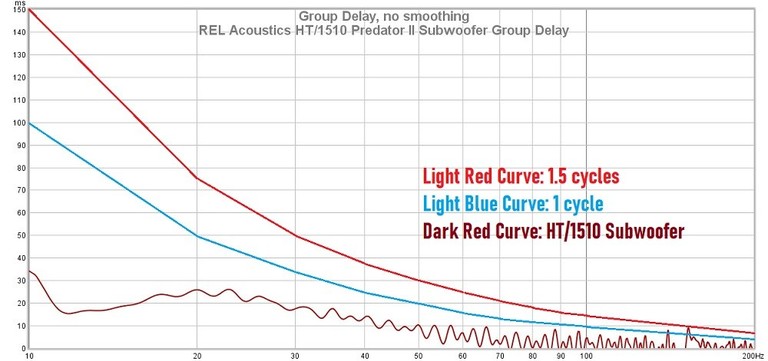
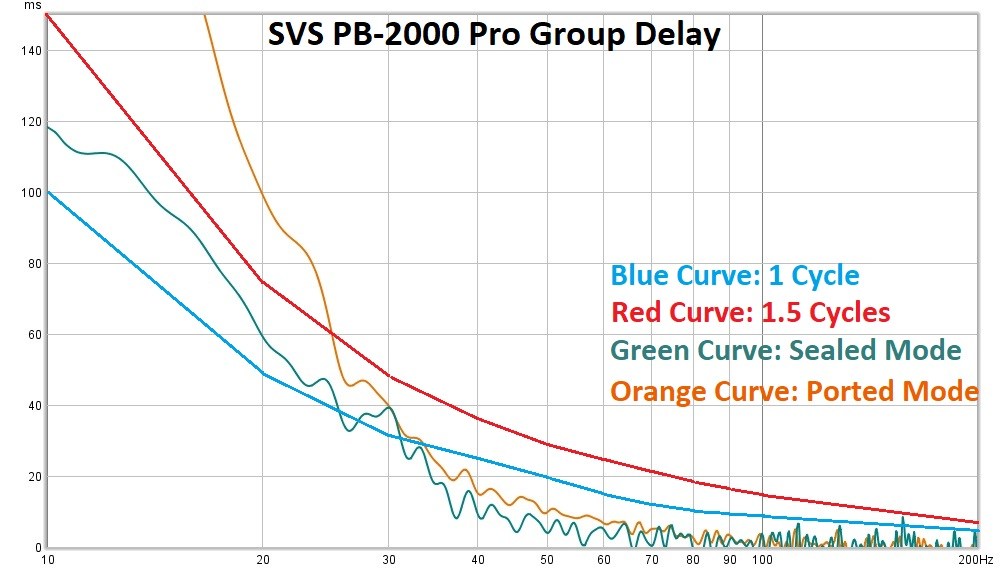
In contrast, if you look at the group-delay graph of the SVS PB2000pro below, it is clear that SVS is using DSP to shape the response below 40Hz and do so heavily under 30Hz. This allows them to put better numbers on a the spec-sheet but it reduces the headroom for YOU to apply DSP suited to your own space.
What is not shown in the measurements is the speed at which the carbon fibre cone moves – and especially stops on the Predators. It is lightening fast. Some of what I thought were my room interactions, were actually a lot of time-domain distortion the PB2000s were adding into the room. There was no boominess or overhang with the Predators unlike with the PB2000s. In fact, the back row seats were sounding a lot cleaner and less boomy overall even without having applied any Multi-Sub Optimisation. Wow!
Also, for a subwoofer, the distortion measurements are really very very good for the REL Predators. However, this was also a double-edge sword. As I found out later as I was doing the Multi-Sub Optimiser (MSO) listening tests, you can make yourself deaf by not realising how loud you are listening. This is because we tend to detect loudness using distortion – amongst other things. When there’s so little distortion, you just want to keep turning it up without realising just how loud it is.
So after one of my 10min listening sessions, I had my ears ringing and was dizzy to the point of almost wanting to throw up. Then I looked and I accidentally switched off DSP correction for the subs and the response peaks were running about 20dB too hot in the room. Ok, no wonder I almost chucked my lunch up and my ears was ringing. These subs can knock you stupid if you aren’t careful.

Multi-Sub Optimisation
Ok, so let’s look at some numbers. REL doesn’t use DSP on their unit, and very minimal filtering. This means that the raw response isn’t necessarily as good, HOWEVER, companies that use DSP to tailor the response already lose some headroom out of the gate. So even though the PB2000 was a 500watt sub, some of that headroom is gone.
Not on the REL. All those 800watts are available and that continuous. The peak is somewhere around 1200watts without DSP having reduced that headroom. However, we do need DSP. But even after DSP the REls were knocking the plaster off the walls (literally had to screw the plaster in 2 places as it was flapping about), and knocking me stupid and they could still go louder.
RAW Response – Dual SVS PB2000
The PB2000s are a ported design, which means they drop like a stone after their 17Hz tuning frequency. Also, below a port’s tuning frequency, you have massive amount of group delay – not that SVS doesn’t have that even before that.

Optimised Response – Dual SVS PB2000
The below is the more apples to apples as it is normalised to 80dB. It drops like a stone after 17hz.

If you wanted to cut some headroom for an even more linear response, you need to normalise to 75dB, which looks like below. It is much better under 20hz, but it does introduce a 5dB penalty to headroom and more distortion.

RAW Response – Dual REL 1508
The below is the dual RELs raw response. As you can see, it is very similar to the dual PB2000 with the following exceptions:
- About 10dBs higher than the dual PB2000s
- The low-end actually doesn’t drop off as quickly due to room gain. Even though the REL is rated at 22Hz for its +/-3dB point as opposed to 17Hz for the PB2000, this is not what happens in real life in a room. A sealed unit will have the advantage of room gain whereby the room becomes part of the subwoofer system as the drivers lock onto the room.


Calibrated Response – Dual REL 1508 – All Seats
This is what the REL looks like calibrated to all seats in the home theatre. Note that they are FLAT down to 5Hz once calibrated and they can do this with 10dB extra headroom and play much cleaner.
They additionally have extra headroom to give you a real headache. I have honestly not reached their limits in my room as I am afraid the doors or plaster will get damaged.
Cut off over 150Hz as I didn’t want to calibrate them beyond that. There’s no content there in my own home theatre.

Calibrated Response – Dual REL 1508 – Front 3 Seats
This is what a front 3 seat priority calibration looks like. You can see that this is pretty much a reference line on 85dB with only about a 1dB variability average across the whole range, which is beyond excellent. Even if we only look at the maximum swing, it is 3dBs between 60hz and 80hz. THX’s top engineers would be proud. Well done, MSO! Now you could overlay Audyssey over this and get a bang on flat reference line.
This also has only a 1ms delay between the two subs so as not to destroy the amazing time-domain performance of the two subs.

However, if you wanted to have 0 delay between the two subs, which in my room gives bang on time-domain performance as they are equidistant from the primary position, here is the trace. Not much worse:


Conclusion
Looking at manufacturer specs is really not a good way of discerning performance. The REL gives the kind of Hi-Fi performance and depth to content below 80Hz which is ridiculously good to listen to. Also, because there’s so little group delay, it sounds like the bass is coming from the speakers themselves and not from separate subwoofers, perfectly in sync with the impulse response of the rest of the speakers.
This gives the sound such a real quality that is difficult to put into words.
In addition, these subs have plenty of headroom to achieve excellent in-room response down to 5hz and pressurise a room, at least in smaller home cinemas. Is it going to have the output under 20Hz with authority? Probably not. But it will deliver it well and won’t introduce any objectionable distortion in that range unlike ported designs.
While you do need more units for larger rooms to provide enough head-room, the units are designed to be stacked 3-high with a clever bracing system that comes with each unit and input – output daisy-chaining.

To quote someone who works at one of the local Home Theatre stores: “We had 6 of the REL HT/1508 Predators set up in our demo room for a while. I miss them. It was the best sound I ever heard!”
I’d like to second that! If the HT/1508 is this good, I am wondering what the HT/1510 sounds like…
Discover more from Simple Home Cinema
Subscribe to get the latest posts sent to your email.
Great write up Roland. I have a single PB2000 pro now, my third ported SVS sub in a row. I am itching to try a larger sealed sub like the Rel 1510 and curious how different my system would sound dropping it in instead of the PB2000 pro and running my YPAO. My PB2000 pro is just so good on paper but I am still curious how the REL sounds.
Hey Dallas,
Well, the REL 1510 is in a different league altogether, I can tell you that. It was like switching from a cheap big brand speaker to actual high-end hifi. The clarity of sound is something else and affected our enjoyment massively.
However, be mindful that the REL needs a bit more aggressive EQ as it doesn’t shape the response using digital filters. So I would recommend you either learn REW and correct the response manually using YPAO or get a MiniDSP and learn MSO. That would give you the very best response, especially if you had two RELs to even out the response in the room.
One other thing you need to be aware of… the SVS can sound big in larger rooms as it’s ported. The REL needs to be able to pressurise the room as it’s sealed. So just be mindful around proper matching to room size. Otherwise go for it, and let us know what you found out!
This is a great write up, exactly the information I was looking for. I currently have a REL HT1205MK2 and looking to add a second subwoofer as I think it will make a huge difference in my room. The question is, do I add a second HT1205MK2 or get an H1508 (there’s the odd one still left around) or the HT1510? I’m wondering how well a larger sub would pair with my 1205 or should I just stick to 2 identical subs?
Hi Jonathan. Thank you!
REL’s HT line are good matches to each other, so you can mix and match. If you get a REL Predator, you can match it with another once you find more HT1508s or the HT1510s come down in price, and replace your smaller one. The HT1510 is obviously slightly more powerful with somewhat better low-end extension but I doubt you’d hear the difference unless you were using them in a largish room.
I have performed extensive measurements in my home theatre, and have found that once you do PEQ, group delay and IR are negatively affected. Considering the RELs were very low GD to start with but required extensive PEQ anyway, aren’t you back to square one?
Hi Simon,
Yes, I talk about the time-domain performance of PEQ as a drawback under the MSO review if you search for that. I think I might have suggested some ways to limit the damage there.
However, there’s a huge difference in applying it judiciously to a product that only has analogue filtering and excellent time-domain performance versus to a product that has very heavy digital filtering applied in the factory and comes with massive group delay to begin with.
The REL still sounds miles better with MSO versus SVS out of the box. It’s faster and has better impulse response.
But if you apply DLBC to it, that should get around those issues. My problem with DLBC is that it disables speaker volume adjustment on some AVRs. That wouldn’t be an issue if Dirac had implemented loudness compensation. Take the issue that’s more important to you. Swings and roundabouts unfortunately…